
Anita Schillhorn is a friend of WITI, an independent consultant who formerly ran strategy at creative agencies across the US and lives in Los Angeles.
Anita here. After a recent injury, I’ve been spending a lot of time with doctors. To help me understand how my body works, MRIs and X-Rays have unveiled systems and networks of bones, muscles, nerves. Orthopedists, spine doctors, and physical therapists all read these like a map to see where the jams are, and then use letters and numbers - C5, C6, TFCC - to signify the locations where things have gone awry.
One sprain is in a cluster of bones, tendons and ligaments so fine and tangled it’s like a complex of LA freeways snaking together, and the impact of a little jam ripples out into unexpected areas. Massage therapists dig into my muscles, stretch my fascia, and infrared therapy stimulates blood cells and healing. It’s given me new insight into the human body and how all of its networks weave together.
You may be familiar with many of these systems from basic anatomy, and you’d think by now that we’re technologically capable of mapping everything. Scientists have mapped the genome, cloned creatures big and small, and isolated the chemicals that make our bodies feel hungry, sad, stressed or loved. But there’s still a system running through our bodies that no one has been able to point to, until recently.
Why is this interesting?
Acupuncture has been one of the most effective ways for me to manage my pain. Acupuncturists put needles in my wrist, neck, and shoulder, where the pain is most prominent, but also into unexpected places like my knee, my foot, my ear, my skull. In Traditional Chinese Medicine, this is said to stimulate energy in a system defined by invisible meridians, or channels that run through the body.
Even though these meridians haven’t been visible to the scientific eye, Western medicine made peace with them a long time ago, because this system of poking needles into unrelated body parts seemed to just… work.
The practice of acupuncture made it into the pantheon of accepted medical methodologies in the West through trade, politics, immigration and fascination. But it took thousands of years for scientists to understand the exact physical system that makes it effective.
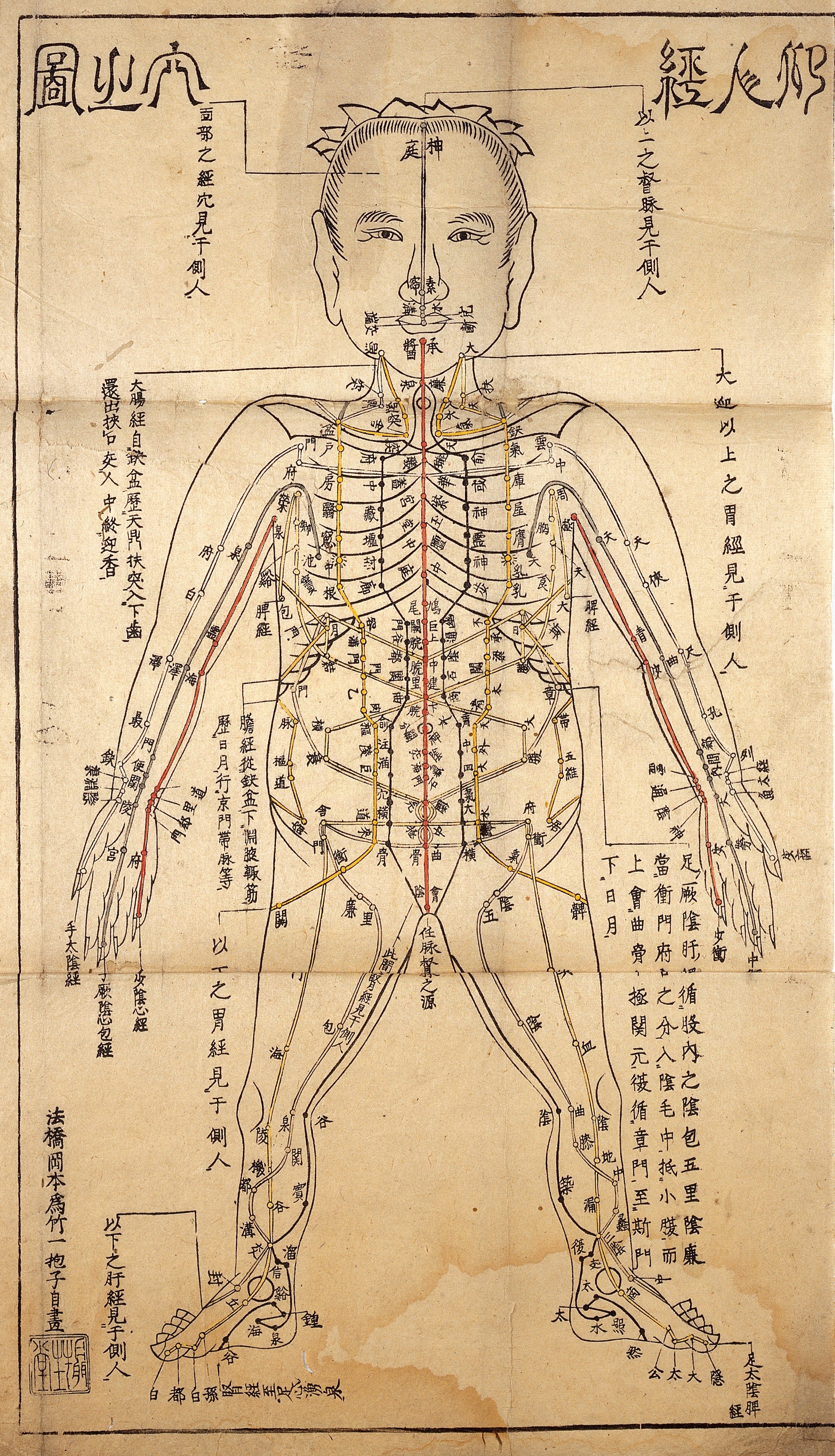
In China, acupuncture predates the common era. Its most foundational text, The Yellow Emperor’s Classic of Medicine, was written around 1st or 2nd century BCE, mapping energy meridians and points along the body the same way that circulatory or skeletal systems are mapped. (In any acupuncture office, you’ll see a poster that builds from this ancient text.)
As European missionaries and traders ventured to China, the West flirted with Traditional Chinese Medicine several times. It caught hold in France, where a unique form of acupuncture developed in the 19th century: The French school of acupuncture created new methodologies like ear acupuncture, and using electric currents with needles.
In the 1800s, Chinese immigrants came to the US as workers to build railroads and other labor jobs. With them came the practice of traditional Chinese medicine, which included herbs and acupuncture. But as the medical system in the US organized and anti-Chinese sentiment grew, Chinese doctors were cast as frauds, and the practice stayed underground and unrecognized outside of Chinese communities.
That was until the 1970s, where a confluence of events brought it into the American mainstream, involving President Nixon and the Black Panthers.
In one of the 20th century’s seminal political meetings, President Nixon visited China in 1972. James Reston, a New York Times journalist, was in China preparing for the visit, and required an emergency appendectomy. A doctor gave him acupuncture for post-surgical pain, and Reston was shocked to learn that a few thin needles alleviated his aches, and wrote about his experience for the paper. That’s when acupuncture began to truly make its way through the US, eventually wooing senators and doctors who granted it legitimacy in the American medical system. Chinese doctors, already practicing underground in the United States, used the moment to finally advocate for a licensing system.
Around this time, a heroin epidemic was decimating the Bronx. Activist groups including the Black Panthers and the Young Lords created a community health clinic to address the crisis of addiction. Distrustful of white doctors then touting the benefits of methadone, one of the movements pre-eminent doctors (and Tupac Shakur’s step-father) Dr Mutulu Shakur advocated for acupuncture. He’d learned about it from a Quebecois school that had stemmed from the French lineage of acupuncture, as well as from community activists in Chinatown. Under him, the clinic developed an ear acupuncture protocol for addiction that’s still used today.
Since the 1970s, acupuncture has gained legitimacy in the US and around the world as an evidence-based, effective medical practice. But Western science still didn’t have a real explanation for how it worked. Until recently.
In 2021, scientists discovered a new system inside of our bodies. They’ve labeled it the interstitium, as it’s a finely woven layer that sits just between the skin and the fascia, carrying fluids like tattoo ink and skincare favorite hyalauronic acid beyond its skin entry point. They also say that it plays a role in how acupuncture actually works; stimulus in one part of the body is carried via the interstitium to a wholly other part.
This means that after millennia of acupuncture working, this mysterious network of energy channels may finally have a physical basis, as solid as a skeleton. And a healing practice that has endured through time, and in the face of skepticism, may once and for all be validated. (ASVV)
Bonus Links:
Dope is Death, a documentary about the Black Panthers’ adoption of acupuncture.
Great article on a subject that never gets old. I hope it encourages more people to try acupuncture.