
The Many-Worlds Edition
On Google's Willow, quantum chips, and a new proof.
Todd Osborn (TO) is a United States Air Force Weapons Systems veteran. He is currently building a flight school.
Todd here. When you think about how the world works, most of what you know comes from things you’ve pushed, dropped, thrown, or tripped over. Rubber bands, baseballs, planets in orbit, springs bouncing back. Your brain is very good at building mental models from that kind of experience.
Quantum mechanics is what happens when those models stop working.
An atom isn’t a tiny weight on a spring. It isn’t a miniature solar system with little planets in neat orbits. Even the fuzzy-cloud picture is wrong. The uncomfortable truth is that it doesn’t behave like anything you’ve ever actually seen.
That’s where the trouble starts. Not with the equations, but with the pictures in your head. Humans instinctively reach for something familiar: marbles, waves on a pond, BBs hitting a target. Anything that fits into the library of everyday experience that your brain has spent decades building and evolution has spent millennia hammering into us for survival.
The famous double-slit experiment—fire electrons one at a time at a barrier with two narrow slits, and let them hit a screen behind it—is where the trouble becomes undeniable. If these were bullets, you’d expect two bright bands, one behind each slit. Instead, as the hits accumulate, you get an interference pattern, with many alternating bright and dark stripes, as if overlapping waves had passed through both slits at once. It looks as if each electron went through both slits and interfered with itself.
Strangely, when you then add detectors to find out which slit each electron actually used, the interference pattern disappears. Two bands, bullet-style. The electron behaves like a particle the moment you ask which path it took.
The standard explanation is that observation collapses the wavefunction. Before you look, the electron is in a both-slits-at-once state, a smear of possibilities. When you measure, that cloud collapses into one outcome. It’s easy to start talking as if there’s something magical about observation, as if consciousness itself reaches in and rewires reality.
But there’s another way to read the same mathematics that doesn’t require any of that.
In the many-worlds view, the wavefunction never collapses. It just evolves, smoothly and continuously, according to one simple rule: for everything, all the time, including you, the detector, and the rest of the lab.
Before the electron hits the detector, treat the whole system (electron, apparatus, you) as what’s called a ‘Quantum superposition,’ where multiple outcomes can be happening at the same time. When the measurement happens, that superposition doesn’t vanish. The universe branches. In one branch, the detector clicks “left” and there’s a version of you who sees that. In another, it clicks “right” and there’s a version of you who sees that. Both outcomes exist. Neither version of you feels the split. You just experience one branch as your reality, with a perfectly ordinary history to go with it.
Without detectors, the electron’s different paths remain part of the same coherent superposition, so they interfere and you get the pattern. Once you install detectors, the which-slit information bleeds into the environment: electronics, air molecules, your retinas. The branches separate so thoroughly they can no longer interfere. From inside one branch, it looks as if the act of measuring changed how the electron behaved. From the outside, nothing sudden happened. The wavefunction kept going. You went with it.
Why is this interesting?
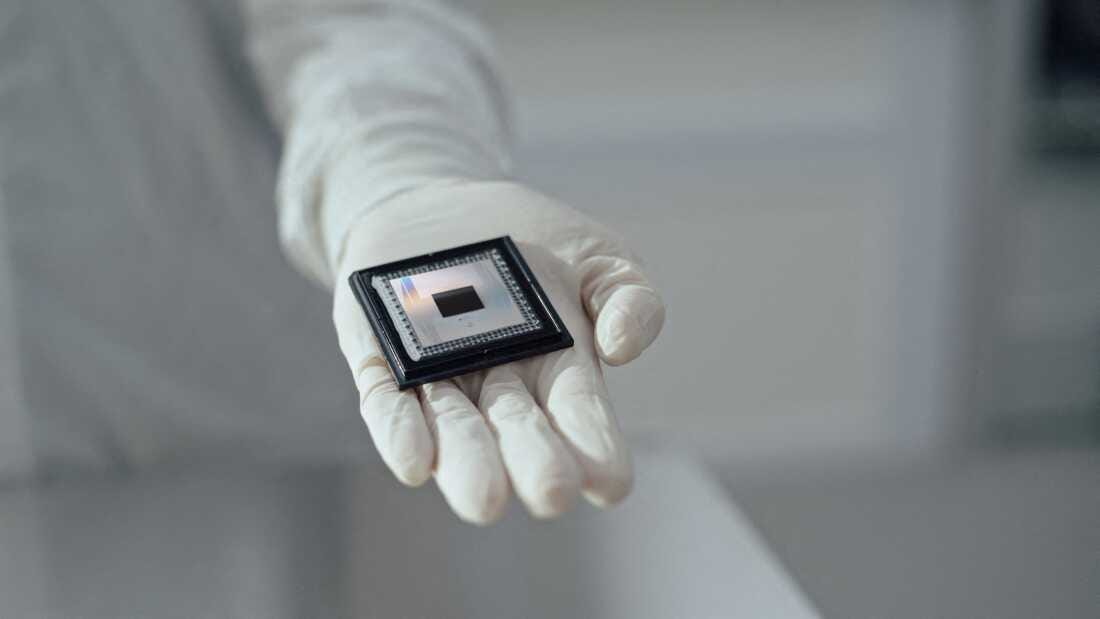
Last year, Google’s Willow quantum chip gave this interpretation something more than philosophical plausibility. Willow solved a benchmark computation in under five minutes that would take the fastest classical supercomputer 10²⁵ years, longer than the age of the universe. Hartmut Neven, who founded Google Quantum AI, argued that this performance only makes sense inside the many-worlds picture.
The chip isn’t picking one outcome and working from there. It’s letting the wavefunction evolve across all possible states at once, and the answer emerges from the interference of all those paths. If the wavefunction were collapsing, if there were only ever one branch doing the work, the computation couldn’t happen. Willow is a chip that only works if many worlds are real.
The quiet twist in all of this is that you aren’t standing outside the experiment, watching like some referee. You’re part of the same quantum system. When you observe, you’re not forcing the universe to choose. You’re getting entangled with it. Different versions of you end up correlated with different outcomes.
From inside one branch, it feels like there’s one universe, one history, one you. That feeling is accurate to your branch. But the mathematics that predicts the interference pattern, and its disappearance when you measure, is suggesting that reality is larger than any single thread of it.
Willow is the first lab-scale hint that this isn’t just a philosophical interpretation. It may be how computation actually works, which means it may be how reality actually works. Your everyday experience has wired you to expect one solid world on a single timeline, because that’s all you’ve ever known from inside your branch.
The atom doesn’t just resist being a marble or a miniature planet. The resistance goes deeper: reality itself keeps exceeding what any one branch of it can see. (TO)