

Jeremy Smith runs the excellent clothing store Standard & Strange. Happy to have him with us this week.
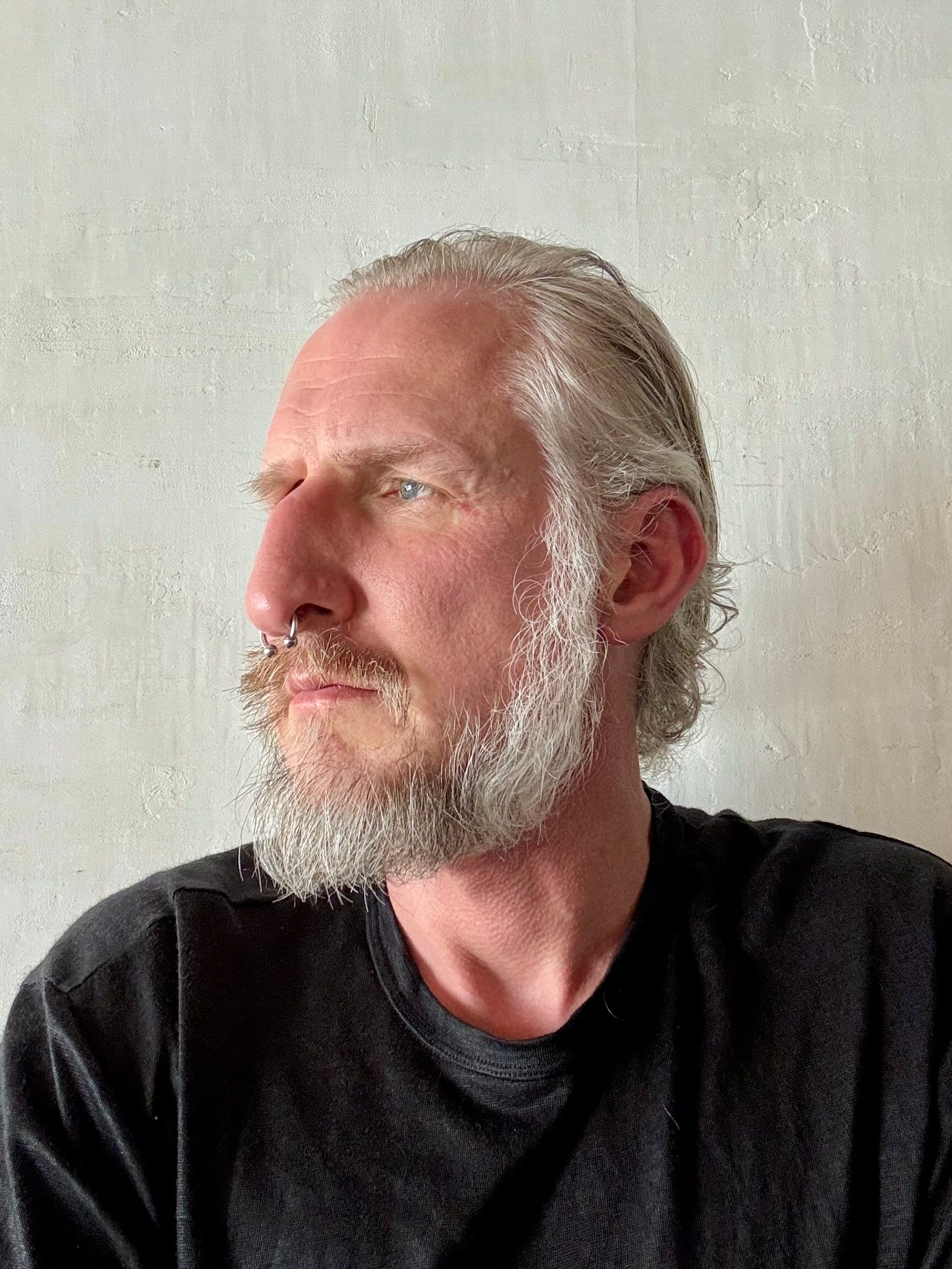
Tell us about yourself.
I’m the owner and co-founder of Standard & Strange, a clothing store in Berkeley CA, Santa Fe NM, and Manhattan (and online). I’m based in Kōbe, Japan, managing our relationships with our Japanese brands, and developing our in-house products.
Describe your media diet.
Completely and totally unstructured, in counterpoint to where I was 20ish years ago. I had a very rigid structure, that was in parts strategic, aspirational, and honestly a little performative. Google Reader had all the de rigeur menswear and style feeds, magazines were along the lines of Monocle, Smith (RIP), 032C, and other things in that genre. Books were a mix of business books (replacing an MBA by just reading all the material), non-fiction, and literary fiction (terrible name for a category).
All of that fell away when I started to understand how that media diet was constraining my thinking and perspectives. Nothing I was attempting to create was coming from the heart; it felt mostly like I was trying to build something to fit the shape of the world I was observing through that lens. Trying to build for now, and not for the future, and doing that oriented around external aesthetics and ideals kept me frustrated for an unnecessarily long time.
Right now, I try to stay wide open and curious. The selection process for everything is entirely happenstance and serendipity. Of course I have lists of books to read, albums to check out, things to watch, magazines to peek at, but oftentimes, whatever I’m consuming will have been found in the moment.
I barely even look at the news anymore, as I’ll find out about today’s fresh horrors via texts and dm’s from friends. I consume Instagram, partially because I’m a visual person, and partly because about 30% of my friends only communicate with me via DMs on that platform. I like the idea of substacks, and I subscribe to a few, but the friction of opening my email tends to keep from diving into them. Podcasts fell off, for some reason I lost patience with them, or else I’m just not getting good recommendations.
What’s the last great book you read?
“Project Hail Mary” by Andy Weir. I am a huge science fiction fan, and his commitment to the “science” part makes for a good read. I watched the movie first, because my son couldn’t wait; and it didn’t ruin the book one bit. That alone is testament to the quality of his writing. The mechanics and details alone make you forget that you know the basic story arc.
What are you reading now?
I’ve got a few books going. Taiwan Travelogue by Yang Shuang-zi, which was heavily recommended by a lot of my friends. So far, it’s fantastic, with no slow spots. Complex, but not over the top. Surprise, Kill, Vanish by Annie Jacobsen, which continues on topics I picked up from reading Stephen Kinzer (see a couple questions down).
I’m also struggling through the manga for Spy Family and Chainsmoker Cat (which is now on Netflix), very very slowly.
What’s your reading strategy when you pick up a print copy of your favorite publication?
It sounds like this is a magazine question. Usually I’ll flip through and see if I’m interested in investing my time in it. If it’s in English, I just go cover to cover, front to back, and assume the editor sorted out the journey for me. If it’s in Japanese, I’ll mark a couple pages that are mostly captions on visuals, and grind through those slowly, and then mark a couple articles for future reading when I level up.
Who should everyone be reading that they’re not?
That’s an impossible question but I’d say Stephen Kinzer if you want a baseline to understand the current events in the world. I started with “All the Shah’s Men”, and then tore through his entire catalog. His work will reframe how you understand the actions of the United States, and its position across modern history. It’s definitely quite grim, but I consider it essential reading now.
What is the best non-famous app you love on your phone?
I feel like I’ve had to answer this one in my prior career for interviews a few times, and I bricked it every time. I have the usual set of apps, and then a few language learning tools. I do love this weather app I replaced the default apple weather with. It’s called Weathergraph, and it’s pretty high-fidelity weather information with a gorgeous display.
Plane or train?
If at all possible, allowing for time and geography, I’ll take a train. I hate framing anything in terms of productivity, but if I need to catch up on work, I’m going to be able to get more done on the train than on a flight. I never really have nothing to do, there’s always more research, more studying, more reading, but the train also offers the option to put on some music, stare out the window, and let my mind wander in a way that isn’t possible at 30,000 feet.
What is one place everyone should visit?
China, which I know is pretty non-specific. I worked in Guangdong for a couple years and it radically changed my perspective on China and the version of it we get in the media. These days a lot more day-to-day content is available on Instagram et al, but at the time, there really wasn’t much out there
Tell us the story of a rabbit hole you fell deep into.
I think this has been said more than once on MMD. My life’s work is one gigantic rabbit hole. In conversation, I frame it as peeking over the next fence, and peering around the next corner. I have an insatiable need to know how things are made, and why. Previously, while going deep into denim (and I’m far from done there) I wound up collecting and learning how to operate every machine involved in making a pair of jeans. Turns out I hate making jeans, but gaining the understanding to make a pair of jeans legible across the different measures of excellence was priceless.
My current rabbit hole is the history of footwear here in Kōbe and this prefecture (Hyōgo). It started with a vintage tin sign advertising tabi shoes made in Nagata Ward. That led to chasing that brand into the past, and discovering the scale of the rubber industry that had existed here pre-war. That industry evolved from the match-making industry around the end of Meiji and into Taishō; in turn many of those rubber companies have consolidated with bigger players, or simply ended operations with time and retirement. The motivation for this exploration is to get a sense of the visual identity of footwear and footwear components at the time, as I work on the branding for the boots I will be releasing 2027.
Learning to operate the machines behind a pair of jeans is an unusually valuable form of product education. It changes how you assess construction and price. More founders would benefit from following one garment through every production operation.
really enjoyed this feature!