
The Please Call Again Edition
On plastic, accountability, and small town charm

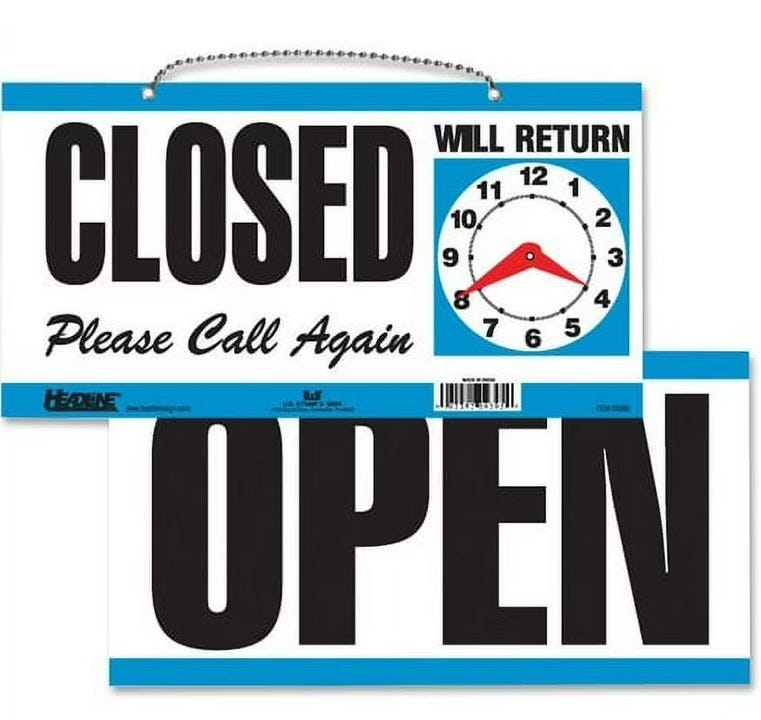
Colin here. There is a sign hanging in the window of nearly every dry cleaner, bodega, nail salon, and alterations shop in America. You have seen it ten thousand times without really clocking it. One side says OPEN in bold block letters. Flip it and you get CLOSED above a cursive script that reads Please Call Again, beside a small analog clock with adjustable plastic hands pointing toward the promised hour of return. It costs about eight dollars. It is manufactured by a company called Headline Signs, a brand of Identity Group, part number 9395, ISO 9001 certified and has been in continuous production for decades.
The phrase “call again” is British English, drawing on the older sense of “to call upon” someone, meaning to visit. So what we have is a piece of injection-molded American plastic, sold at Staples and Walmart, carrying an 19th-century British verbal construction that a significant portion of the population under 30 cannot parse at face value. Got it!
Why is this interesting?
The object itself has delightful contradictions. “CLOSED” is set in high-contrast uppercase, the typographic register of regulation and function, the language of parking signs and warning labels. “Please Call Again” is written in cursive, the register of warmth, of handwritten notes, of the personal. These two modes live on the same piece of plastic, covering the entire emotional project of the American small business: I am a commercial entity that also genuinely likes you.
Then, the actual clock. Setting those hands when you pop out for a coffee break is an act of accountability. The shopkeeper who moves the plastic minute hand to 3:00 is making a promise of sorts! You came, I wasn’t here, I will be here at this time, and I expect you to come back. It is a delightful, old-school social contract that predates the phone, the internet, and the entire infrastructure of Door Dash everything.
That pleasant cursive “Please Call Again” is softly saying your return is desired, expected, and worth encoding in plastic.
The sign stays in the window because replacing it would require deciding to replace it, and nobody has time for that, and besides, a new version would cost eight dollars.