

Todd Osborn (TO) is a United States Air Force Weapons Systems veteran. He is currently building a flight school.
Todd here. Vinyl records are not naturally black. They are made from PVC, which begins life clear, or at least, translucent. We just think records are black because almost every record we have ever seen is black. The tint comes from carbon black, a fine carbon powder mixed into the PVC that colors the record, and which also makes the compound tougher, more stable, and somewhat conductive. Without it, PVC is a very good insulator, and a record that holds a static charge is a record that attracts dust. Dust which will turn a perfectly good copy of an album into a tiny crackling campfire in your headphones as the diamond stylus moves through the groove.
Black records, therefore, have acquired a reputation as the serious version: The “real” record you bought, before labels decided your collector’s copy needed to look like a lava lamp. This reputation was also not completely unfair, because for a long time, colored vinyl could, like translucent vinyl, be a little riskier too. Different pigments and additives require different handling. Some colors are more demanding than others. Black, as the default color that vinyl stampers would have been trained on, was familiar and forgiving. A black record was not automatically better, but it was usually the safe bet.
Colored vinyl today is much better than it used to be. A good modern pressing on red, blue, white, or clear can sound as good as black. The mastering and the plant matter much more than pigment. But color changes at a pressing plant can also produce records that are far more interesting than the colors anyone ordered.
Suppose a plant has been pressing black copies of an album all day. Then it switches to red. The press does not instantly become red, because the black material is still in the extruder, the feed system, and all the various places where hot plastic has been moving around all day. The plant puts in the red PVC pellets, and for a short period, the records coming out may be neither black nor red. They may be red with black streaks. Or black with red smoke. Or brown. Or dark red at first, then progressively cleaner and brighter as the old material finally works its way out. Eventually, the press makes the red record the label actually ordered. But before that, it makes transition records, also known as setup copies, purge copies, rejects, waste, etc. Some are thrown away. Some go home with people who work at the plant. Some get handed to the label. Occasionally, somebody recognizes that the ugly accidental copy is actually the interesting one and sells it.
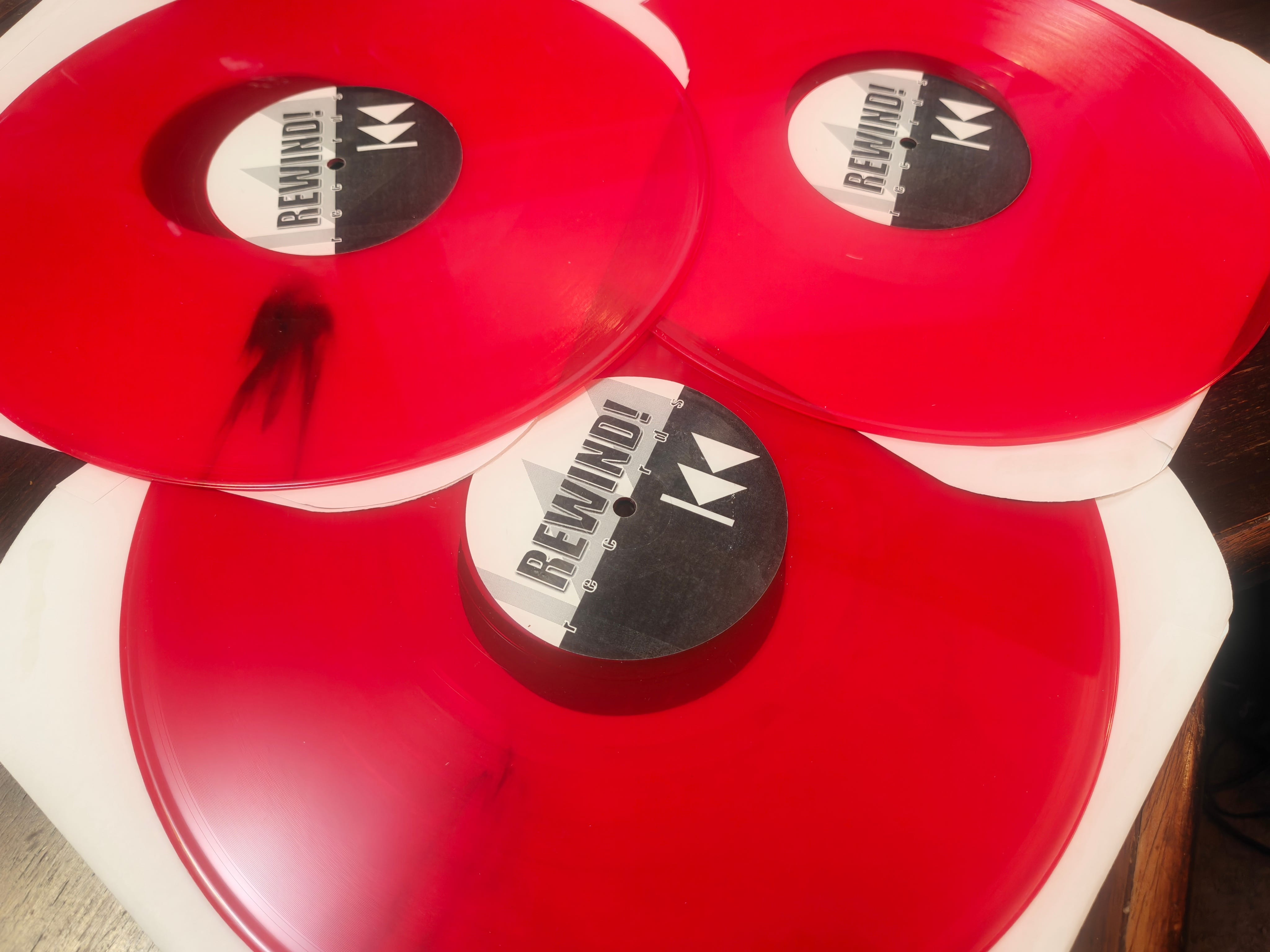
Collectors call them variants, because collectors need a word for everything. But they are more than variants. They are likely among the earliest records pressed in that color run, because a red record with obvious remnants of the previous black run is evidence of where it came from in the process. The grooves tell you what was on the master tape, but the color can tell you what was in the machine just before it.
Why is this interesting?
Because this is also how Dum-Dums work.
The ‘Mystery Flavor’ Dum-Dum is (or at least often has been) the candy sucker equivalent of a transitional vinyl record. The factory is making one flavor, then changes to another. It does not want to stop the line, flush out every last trace, and spend time ensuring that root beer ends at one precise point and cherry begins at another. Instead, the last of one flavor meets the first of the next, and the hybrid gets the ubiquitous question-mark wrapper.
Dum-Dums describes its Mystery Flavor only as something that “continuously changes” and is not limited to its current listed flavors. Accounts of the production process describe it as the overlap between flavor batches: not a secret recipe, but the brief moment when the machine has not entirely made up its mind about what it is producing.
This is a much smarter idea than inventing another artificial flavor. The company takes the unavoidable residue of production that’s normally discarded or cleaned away, and sells it as a mystery.
A transitional record is the same thing, except it gets listed on Discogs, with somebody claiming that “the black streaks make it sound warmer...”. We tend to think of these manufactured objects as careful decisions, but both simply reveal the normally hidden boundary between two production runs.
A factory is supposed to make black records and then make red records. It is supposed to make grape candy and then make watermelon candy. The machinery is supposed to disappear behind the finished product. But sometimes it fails to disappear, and it can become one of the most uniquely interesting things they make. (TO)
Interesting article to me, as I worked in pvc extrusion making flexible medical tubing. And I collect old records lol.