

The Wildberries Edition
On the OSS, Amazon Prime, and long-range sanctions.
Chris Papasadero (CP) is a screenwriter, consultant, and former Green Beret in the U.S. Army’s Special Forces. He previously contributed the Cloud Brightening Edition and the Future of 007 Edition, as well as many others.
Chris here. During WWII the Office of Strategic Services published its Simple Sabotage Field Manual, a doctrine for training citizen-saboteurs across occupied Europe. The manual is today known as a troll of modern management, but in “special military operations,” guerrilla tactics are allowed and encouraged.
Among the highest-priority targets for the OSS were supply depots. These are “outstanding targets” as they concentrate value, are vulnerable to fire, and easily targeted.
Why is this interesting?
This month, Ukrainian long-range drones have hit at least eight of (online Russian retailer) Wildberries’ distribution centers.
The strikes have knocked out roughly ten percent of the company’s total capacity. Russian Forbes estimates that restoring that capacity could cost the debt-laden, low margin business 33 billion rubles, with sellers’ lost inventory running to at least 150 billion rubles – a nearly $2.3 billion combined loss for the ‘Russian Amazon’, which handles just over half of Russia’s online retail.
Ukraine’s stated rationale for the ‘long range sanctions’ is that Wildberries warehouses move military hardware alongside consumer goods; a search of the Wildberries website found body armor, helmets, radios, and electronics – some labeled as field-tested in the “special military operation.”
This is a textbook application of the CARVER matrix, also an OSS favorite: Criticality, Accessibility, Recuperability, Vulnerability, Effect, Recognizability.
High criticality (half of Russia’s e-commerce).
Moderate accessibility using long-distance drones (warehouses are big, fixed, and dispersible only at enormous cost).
Low recuperability (rebuilding a million-square-foot distribution center takes years, not weeks).
High vulnerability (concentrated flammable inventory).
And then the variable the OSS understood better than anyone: effect. When a Wildberries warehouse burns, thousands of sellers lose inventory and take to the internet to complain, while the company – debt-laden and with razor-thin margins – threatens to further collapse Russia’s economy.
During COVID, America’s Cybersecurity and Infrastructure Security Agency designated e-commerce warehouse workers as essential critical infrastructure – an implicit acknowledgment of how dependent the U.S. had become on a small handful of commercial logistics networks. Earlier this year, Iranian drones struck AWS data centers in the UAE and Bahrain, and a House Homeland Security subcommittee held hearings on whether data centers – many also owned by Amazon – should be designated as their own critical infrastructure sector.
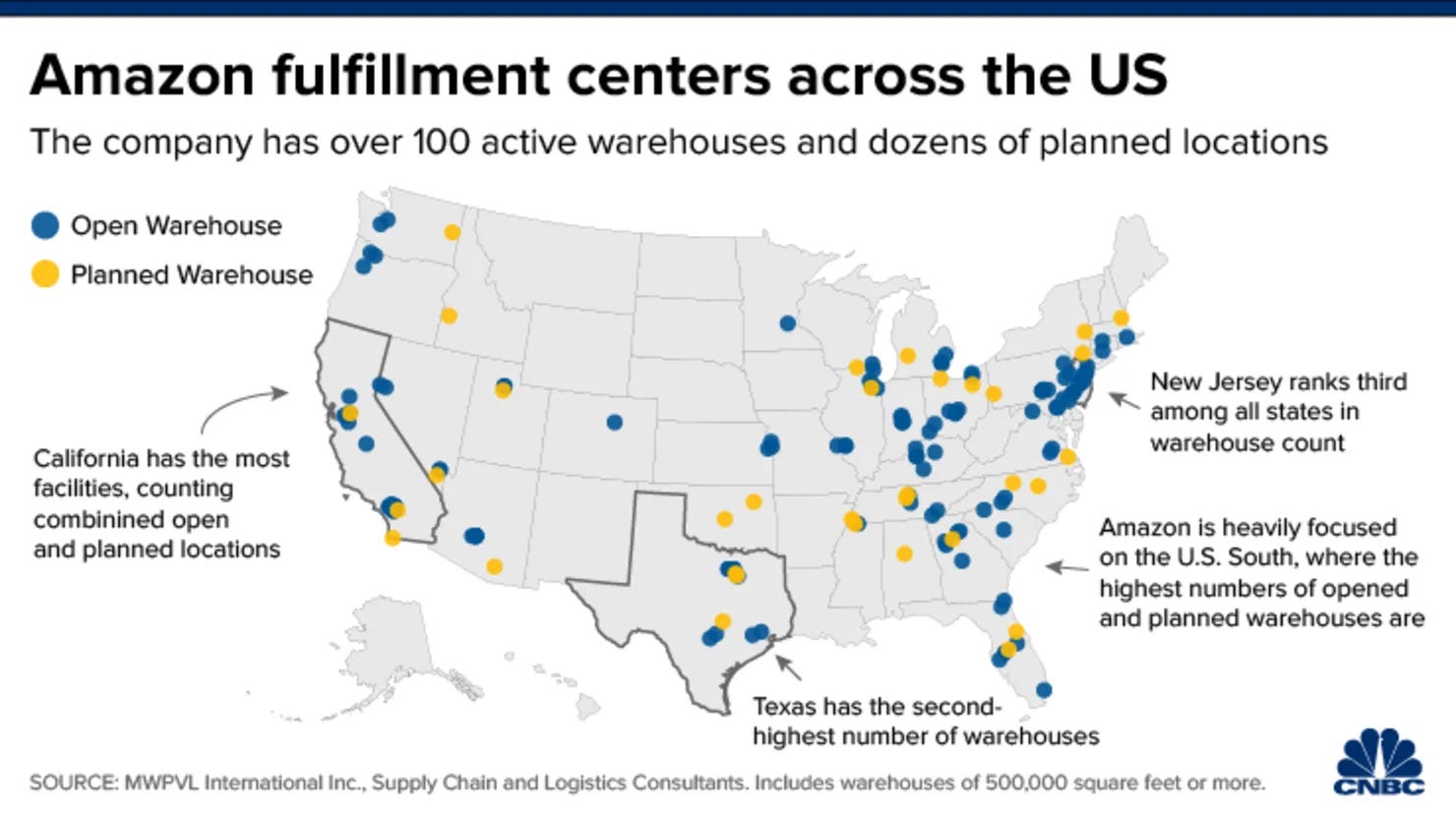
This concentration of value is now a feature of modern commerce. It is also not a vulnerability unique to Russia. (CP)
Fascinating- thank you.