
The Consciousness Edition
On Labatut, John von Neumann, and modern physics.
First, a quick announcement: WITI’s Noah Brier has started a new podcast and publication called Forward Deployed, at the intersection of AI, engineering, and the enterprise. It’s a home for conversations about what’s happening in the trenches as companies work through adopting AI. He’s particularly interested in what we can learn from other industries—especially creative ones—about creating aligned, agentic systems. Please subscribe and join him in the journey.
Benoît Pellevoizin (BP) is a strategist and marketer. I first met him when he worked at FRED&FARID, and am always impressed with his thinking and taste.–CJN
Benoît here. I’ve always been a materialist, in the philosophical sense (and sometimes the clothing one.) Like most Westerners in the 21st century, I was raised on materialist principles: the idea that consciousness arises from matter, not the other way around. It’s what they teach at school. It’s the dominant view in science.
Then, I read Benjamín Labatut’s When We Cease to Understand the World. There’s something of W.G. Sebald in the book, but it adds a fascination with scientific history that makes it unique. Across 200 pages, Labatut tells the stories of the physicists who uncovered the rules of the subatomic world: Heisenberg alone on Helgoland in 1925, Schrödinger curing tuberculosis in an alpine sanatorium, Schwarzschild computing the geometry of black holes from a Russian trench. He writes them as tragic heroes. Men who got too close to something humans aren’t built to see.
I closed the book convinced that I needed to actually understand quantum mechanics. Not the equations… the thing. What broke these men.
Why is this interesting?
Because the rabbit hole leads somewhere most of us never hear about. Send electrons one at a time through two slits, and they form an interference pattern, as if each one passes through both slits at once. Put a detector at one slit to determine which the electron actually went through, and the pattern collapses. Looking changes the result. The question of what counts as looking has haunted physics since.
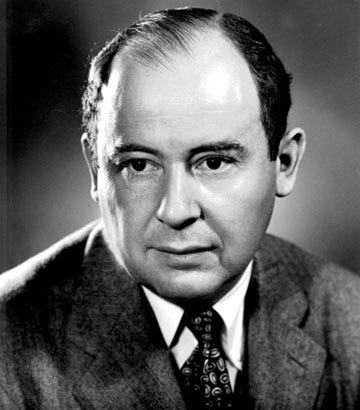
Enter John von Neumann. If you don’t know him, he invented modern computing, co-built the atomic bomb, founded game theory, and wrote the book that put quantum mechanics on rigorous mathematical foundations. When he was dying of cancer in 1957, the U.S. military stationed personnel at his Walter Reed bedside around the clock. Not for protection, but to prevent him from accidentally revealing classified secrets in his delirium. The state thought one man’s wandering mind was a national security risk.
In 1932, this man pushed the measurement problem to its logical end. The detector that observes the electron is itself made of atoms, which are quantum. The eye that reads the detector, quantum. The neurons firing in the brain, quantum. The “chain of superposition” propagates indefinitely; nothing physical can break it. And yet it breaks when we decide to look, at which point we always end up seeing just the one clear result.
Von Neumann’s conclusion, reached not as a mystic but as the most rigorous mathematician of his century, was that the break must happen outside the physical. Consciousness is what collapses the wavefunction. Consciousness is what turns the possible into the real. Being aware is what forces reality to “choose” one outcome.
Most physicists prefer interpretations that keep consciousness out. But von Neumann’s argument has never been refuted. A century on, it remains a live option, defended by serious people.
Now, here’s what bothers me. I’m 40, and only now discovering that some of the most rigorous minds of the 20th century thought consciousness might be the basis of our reality, and that this idea has been explored for three thousand years by Vedanta, Buddhism, and even gnostic Christianity. We teach kids calculus and the Treaty of Westphalia. We don’t teach them that the foundations of physics are philosophically wide open. We treat metaphysics as a subject for retirees and stoned undergrads, when it’s actually the operating system underneath everything else. A semester of comparative metaphysics at 16 wouldn’t make anyone a mystic. It would inoculate against unexamined materialism.
The world is stranger than the picture they hand us at school. The brightest minds in history have known it for a long time. Most of us have been spared the news.
Quick Links:
Benjamín Labatut, When We Cease to Understand the World — the human side, in fiction
Adam Becker, What Is Real? — the physics, done well
Bernardo Kastrup, The Idea of the World — the philosophical argument
Thanks for reading. (BP)
Nice column!
Yep, I am a physicist and the world is stranger. Many people invoke physics to show the world is materialistic and they don't understand that the deeper you go into physics, the less materialistic it becomes.
Here is a column that I wrotein 2001 about this:
OR
file:///Users/emanuelderman/Documents/ederman%20website/Previous%20websites/ed.old.com/Experiment/ederman.com%20copy/RecentColumns/GreatPretender.html
And here are the last few paragraphs of that column:
"I find myself relying on a critical difference between people and Nature as an explanation of the inadequacies of financial theory. But aren’t people part of Nature too? Schrodinger, the unconventional father of the wave equation in quantum mechanics, wrote a short summary of his personal views on determinism and free will in the epilogue to What is Life? his influential lectures on the physico-chemical basis of living matter. “My body functions as a pure mechanism according the Laws of Nature,” he wrote. “Yet I know, by incontrovertible direct experience, that I am directing its motions, of which I foresee the effects, that may be fateful and all-important, in which case I feel and take full responsibility for them.”
The only way he could reconcile these two apparently contradictory experiences-his deep belief in the susceptibility of Nature to human theorizing and his equally firm sense of the individual autonomy that must lie beneath any attempt to theorize-was to infer that “every conscious mind that has ever said or felt ‘I’ … [is] the person, if any, who controls the ‘motion of the atoms’ according to the Laws of Nature.”
Schrodinger was following a long line of earlier German philosophers who thought that all the various worldly voices referring to themselves in conversation as ‘I’ were not really referring to independent I’s, but to the same universal I-God or Nature. It’s a comforting notion. But it still doesn’t explain why, if all the I’s add up to God, it’s so much harder to predict the world of I’s than the world of God."