
The Creative Parent Edition
On trade-offs, Knausgård, and possibilities.

Kevin Maguire (KM) is a strategist, coach, dad, and the author of a new book publishing this week: ‘The New Fatherhood: Why Everything They Told You About Being A Dad Is Wrong, and How Embracing It Will Transform Your Life.’ He’s previously written WITIs about the rickshaw, the B-side, voice memos, FC Barcelona and Bluey.
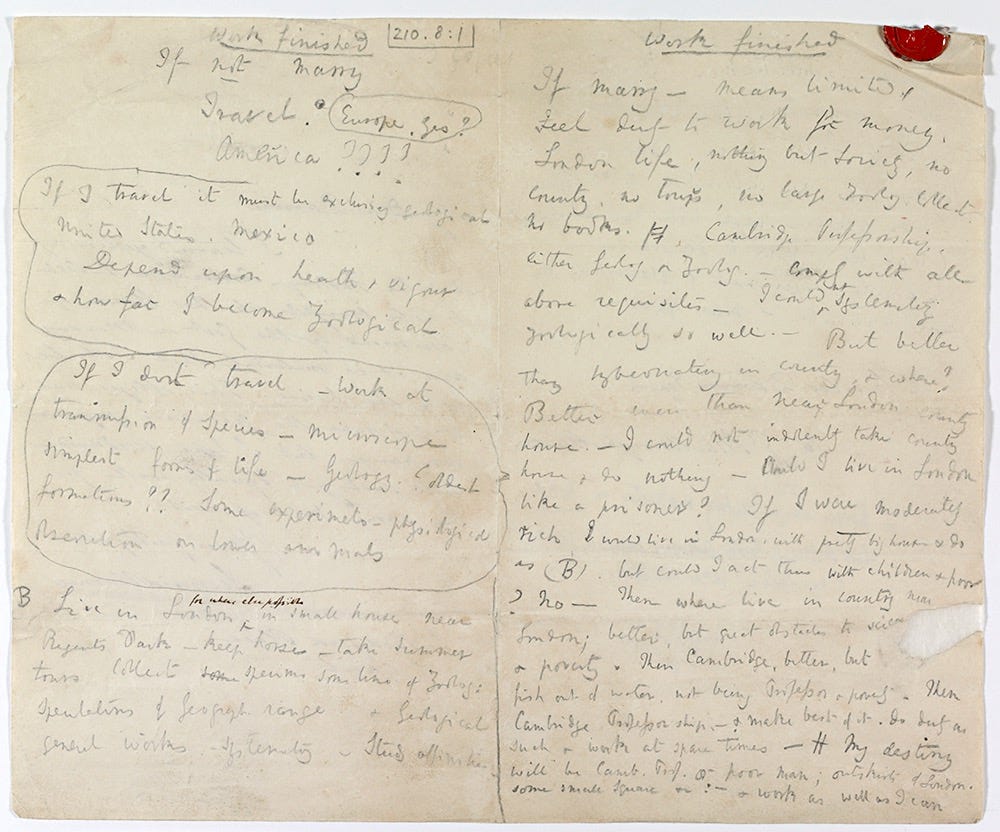
Kevin here. On April 7th, 1838, Charles Darwin opened up his notebook to muse on marriage. He was considering taking Emma Wedgwood, his cousin, as his bride. (This was all the rage back then, putting him in a historical clique with Albert Einstein, Edgar Allan Poe and Jesse James.)
That day, he was wondering if life would be better spent alone or alongside his wife-to-be. To crack this puzzle, one of history’s greatest thinkers attempted to find an answer using—you guessed it—a pros and cons list.
Darwin could clearly see the positives to a life shared with a loving companion:
It is intolerable to think of spending one’s whole life like a neuter bee, working, working, & nothing after all. Imagine living all one’s day solitarily in smoky dirty London House. Only picture yourself a nice soft wife on a sofa with good fire, & books & music perhaps.
But to settle down was to also give up a life filled, in his words, with the “freedom to go where one liked” and the “conversation of clever men at clubs.” That, he feared, would be replaced by “fatness & idleness,” “loss of time,” “perhaps quarrelling,” and “less money for books.” Heaven forbid.
Francis Bacon came down even harder on the institution in his essay “Of Marriage and Single Life,” suggesting that only the unmarried can achieve greatness:
“He that hath wife and children hath given hostages to fortune; for they are impediments to great enterprises, either of virtue or mischief. Certainly, the best works, and of greatest merit for the public, have proceeded from the unmarried or childless men, which, both in affection and means have married and endowed the public.”
Writer and critic Cyril Connolly agreed, famously suggesting: “There is no more sombre enemy of good art than the pram in the hall.” In 2005, Lionel Shriver, author of We Need to Talk About Kevin (not this Kevin, thankfully), wrote a manifesto for the anti-mom titled “No Kids Please, We’re Selfish,” sharing her belief that “my life is far too interesting to spoil it with children.” British artist Tracey Emin sharpened the point in a 2014 interview, making it clear who was picking up the slack in creative marriages: “There are good artists who have children. They are called men.” Some say the answer isn’t to avoid parenthood entirely, but to limit the amount of children you have. Lauren Sandler argued her case a decade ago, suggesting that there was a secret to being a successful parent and writer: “Have Just One Kid.” (Though Zadie Smith herself, a mother of two, clapped back in the comments.)
Why is this interesting?
We live in a society where having children is no longer the default path, and many choose to take the road less arduous. As parents experience the sheer exhaustion that family life brings, it’s only fair to wonder if Cyril Connolly was on to something, and whether the pram in the hall could indeed be a tombstone marking the death of creativity in a household. Might we have more in the tank to give without the constant depletion that raising kids entails?
I can’t offer an unbiased opinion—not with this much skin in the game. Without my son, and my experience with paternal postpartum depression after his birth, I may have never turned my hand to writing—let alone be on the verge of publishing my first book. Fatherhood put me through the wringer in a way that fundamentally transformed how I see the world and the space I choose to inhabit in it.
In his 2018 book Pops, Michael Chabon shared a piece of advice from a writer he admired: “Don’t have children. That’s it. Do not. That is the whole of the law. You can write great books or you can have kids. It’s up to you.” Chabon railed against the advice; a decision he doesn’t regret:
If I had followed the great man’s advice and never burdened myself with the gift of my children, or if I had never written any novels at all, in the long run the result would have been the same as the result will be for me here, having made the choice I made: I will die, and the world in its violence and serenity will roll on …. Once they’re written, my books, unlike my children, hold no wonder for me; no mystery resides in them. Unlike my children, my books are cruelly unforgiving of my weaknesses, failings, and flaws of character. Most of all, my books, unlike my children, do not love me back.
Chabon went on to write The Amazing Adventures of Kavalier & Clay. He also found inspiration—and unbridled joy—in the lives of his children, taking his teenage son to Paris Fashion Week to meet Virgil Abloh, which he captured in a phenomenal essay for GQ: “My Son, the Prince of Fashion.”
Karl Ove Knausgård’s escapades as a full-time father were spread across six books, totalling thirty-six hundred pages. For Knausgård, fatherhood delivered an exothermic reaction to his creative output, rather than draining its vitality away. His first two books had been moderately successful; it was his writing on the minutiae of fatherhood that turned him into a global sensation. His experience on the coal face of parenting proved transformative, and his observations on being the primary carer became the ne plus ultra of dad-lit; detailed explorations of the mundanity of parenthood that continue to inspire readers to seek out the extraordinary beauty of life’s most ordinary moments.
Does becoming a parent make you less creative? I’ll leave you in Knausgård’s capable hands: “The problem is not so much that the world limits your imagination, as your imagination limits the world.” (KM)
Before you go, a reminder: WITI’s Noah Brier has started a new podcast and publication called Forward Deployed, at the intersection of AI, engineering, and the enterprise. It’s a home for conversations about what’s happening in the trenches as companies work through adopting AI. He’s particularly interested in what we can learn from other industries—especially creative ones—about creating aligned, agentic systems. Subscribe and join him in the journey here.
 | A guest post by
|
Loved this one — and hey, Kevin! 👋 Can’t wait to read your book!