

The World Cup Camera Angles Edition
On fruitless innovation, R&D cycles, and Zidane.
Matt Locke (ML) is a WITI contributor and the Director of Storythings, a content agency based in the UK. His previous WITIs include the Andy Warhol Album Covers Edition, the TV Schedule Edition, and the Photobooth Edition.
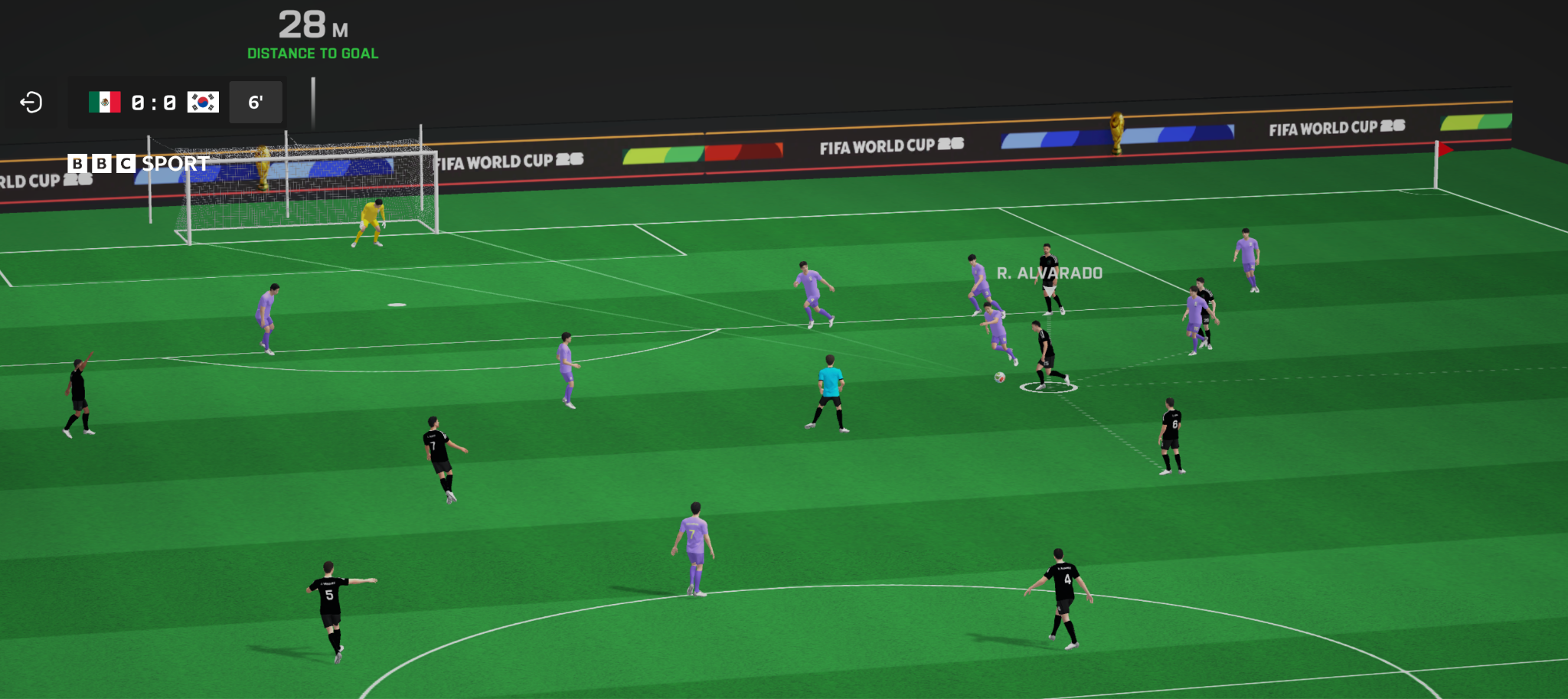
Matt here. Back in the early 2000s, I ran a team at the BBC that was developing future formats for the new media departments. One thing I realised was that some departments had very strong cadences around their innovation. In the sport division, it was closely tied to the cycles of major sporting events, in particular the four year cycles of the Olympics and World Cups.
Four year cycles give R&D teams a perfect cadence to put new ideas into practise. The event is far enough out that you can think about ideas that are not yet ready for market, and yet close enough to stop R&D straying too far into wild fantasy. There’s just about enough time for a couple of rounds of experimentation before you need to buckle down and actually deliver a product.
For the 2026 World Cup, the BBC have launched an interactive 3D visualisation of the games they are covering, giving you the chance to switch camera angles and get live data insights over a CGI recreation of the game. As an experience, it falls into the uncanny valley between EA’s FIFA franchise and the actual live game, running the crowd noise and commentary from the broadcast over the 3D recreation. It’s fun to play with, but not really satisfying enough as a viewing or interactive experience to really hold your attention.
Why is this interesting?
This experiment is part of a long history of innovations in how we watch (British) football, but the most popular, and satisfying, solution still seems to be having a main camera pivoting left and right from the halfway line, with close up cameras to highlight key action points.
The SpiderCam, suspended by four cables hooked to each corner of the stadium, launched in the early 2000s, and has become integrated into the way football is filmed, and the RefCam, introduced by FIFA for this World Cup, adds novelty, but not much else. Both these features are used to bring the viewer closer to the players at key moments, but would be incredibly difficult to watch for a whole game.
The challenge with filming live football is that the game play is so unpredictable and dynamic. Unlike baseball or American football, where the gameplay is broken up into individual plays, football is free-flowing and can quickly shift the audience’s focus to any point on the pitch.
Viewers need to see a large portion of pitch at any one time so you can follow the players’ movements and see plays spontaneously develop. A player 30 yards away from the ball could make a run that opens up a channel, or draws a defender to create space for an attacker to drive into the penalty area. A quick pass upfield from defence can slice through the entire midfield and put an attacker within range for a shot on goal.
This dynamism is better captured by a wide view point from cameras on the halfway line, rather than the tight focus you see on, for example, a pitcher and batter in baseball footage. This is so well established in sports broadcasting that the half-way line camera point is known simply as ‘broadcast view’ or ‘master view’.
Towards the end of my time at the BBC, a colleague asked me if I could track down a recording of one of the first broadcast football matches from the 1960s, as his elderly father was the referee that day. Amazingly, the BBC archive still had it, and burned a DVD copy so that he could share it with his family on his dad’s 80th birthday.
I watched the game before passing it on, and was surprised at how similar the camera movements and various angles of the broadcast were to contemporary football coverage. The images were black and white, with a blurrier resolution, but the broadcast view, with cutaways to closer cameras for key moments, was very similar to today’s coverage. Despite 60 years of technical innovations, broadcast mode still remains the best way to watch live football. (ML)
Quick Links
One of the most interesting recent innovations in sports broadcasting is Cosm, which takes the broadcast view and blows it up into an immersive experience, giving you the impression you’re actually at the match.
Similar hype has surrounded Apple Vision Pro’s sports coverage, although it really doesn’t seem to have helped sales much yet.
As a baseball nerd, I absolutely love Ribbie, which recreates live baseball games using 80s era 8-bit computer graphics. It is so cute it doesn’t fall into the same uncanny valley as the BBC 3D experiment.
If you want to know what a football match shot mostly in close up would look like, watch Zidane: A 21st Century Portrait, a beautiful film by artists Phillipe Parenno and Douglas Gordon, with a soundtrack by Mogwai. Filmed using 17 cameras, it is edited to only show the French maestro for the entirety of a 2005 match between Real Madrid and Villareal. It’s a work of art, and brings you closer to the experience of the players than any immersive technology.