
The Pauking Edition
On curb patience, slow-rolling Waymos, and the price of presence.
Reilly Brennan (RPB) co-founded Trucks and is the author of the widely-followed Future of Transportation weekly newsletter. Past contributions to WITI include the Nancy Meyers Leaf Blower Edition and the Postal Truck Edition.
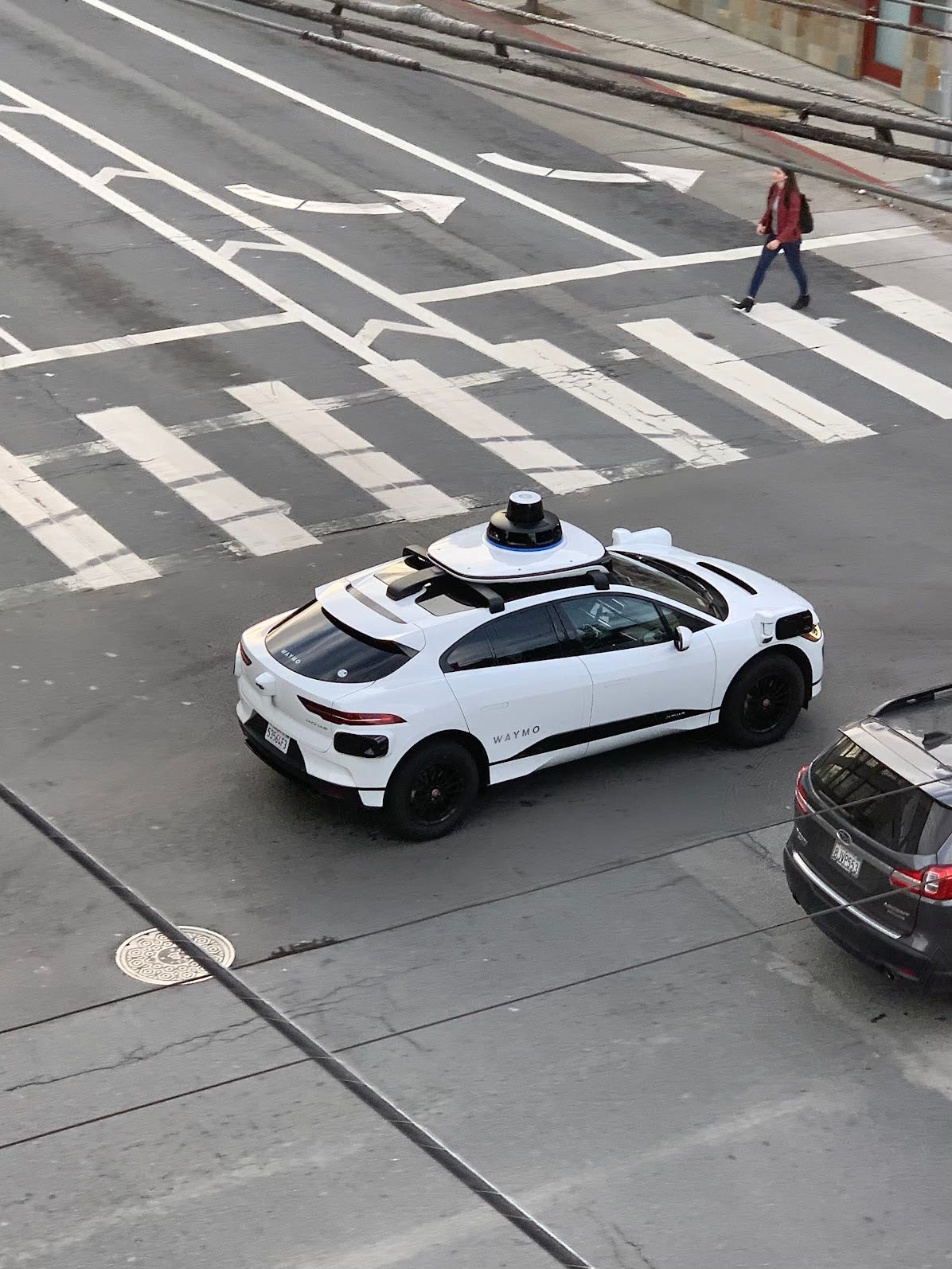
Reilly here. When an Uber arrives, I don’t like to keep the driver waiting: it doesn’t feel considerate, plus I don’t want it to impact my overall score (a long wait time is the No.1 reason your rider rating can decline).
But automated vehicles flip this dynamic on its head: wait times have no penalty and no social contract because there is no driver. Your Waymo gives you up to five minutes of curb patience before it drives off, then it finally charges you a no-show fee.
Why is this interesting?
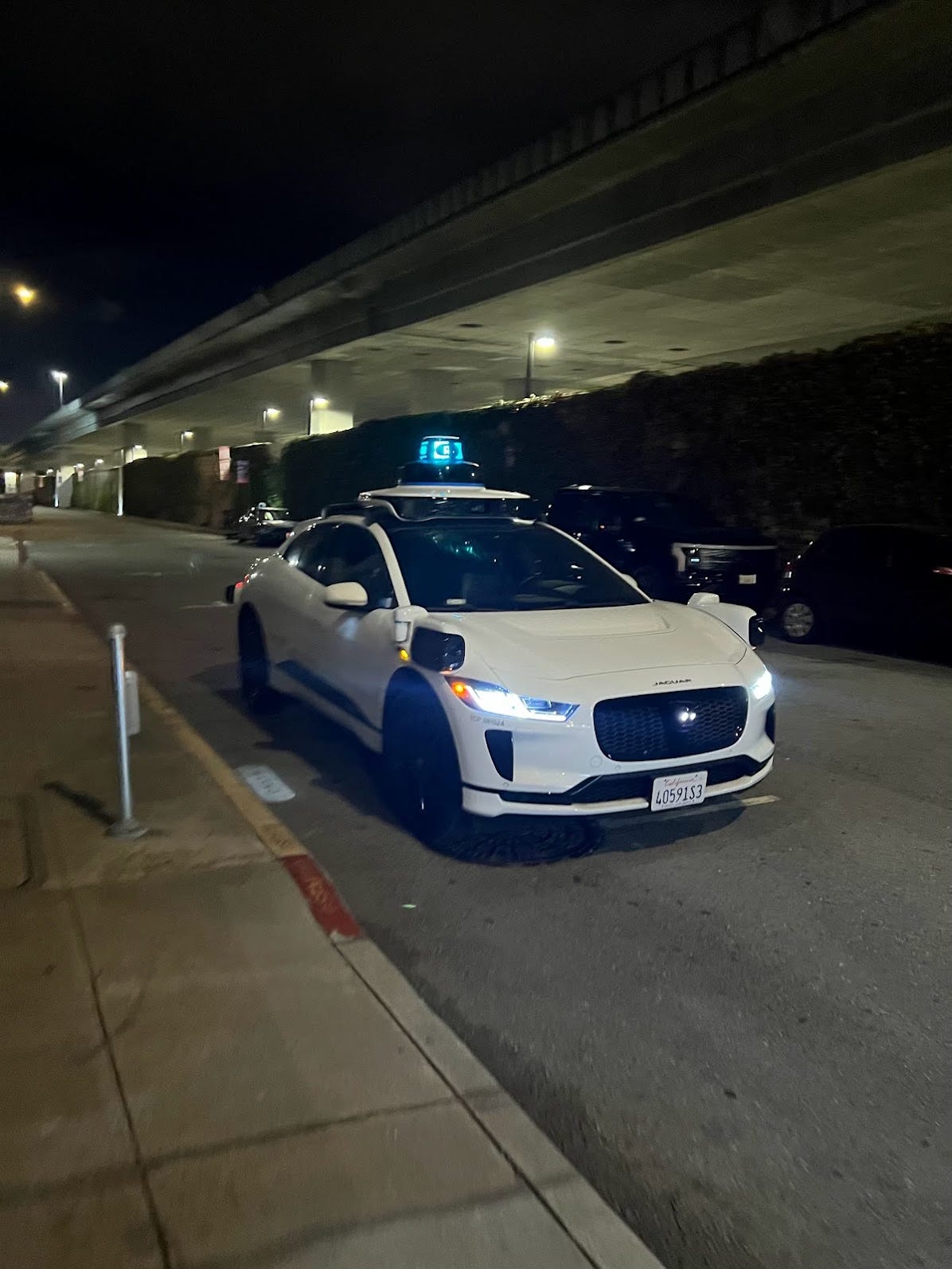
This five-minute window represents something new in the urban mobility landscape. We can’t really call it parking, because the vehicle isn’t stopped. But it’s not moving, either. It’s occupying public space, keeping a lane or curb spot unavailable to everyone else, doing nothing but waiting. We don’t really have a word for this middle state between parking and pausing.
Let’s call it pauking.
Now, cities have long understood that roads and curbs are finite public goods that need to be priced, albeit unevenly. There are three classical pricing models: toll roads charge you for distance traveled, parking meters charge you for time occupied, and gas taxes contribute to road construction costs. Otherwise, you are not charged for the space you occupy during regular street driving.
UCLA transportation researcher Adam Millard-Ball anticipated the pauking problem in a 2019 paper that suggested AVs will likely slow-roll to their pickups, taking advantage of ‘free’ and untolled roadways. His central insight was that “the ability of AVs to cruise blurs the boundary between parking and travel.”
The research modeled what happens when autonomous vehicles try to minimize costs, finding that as few as 2,000 automated vehicles could slow downtown San Francisco traffic to under two miles per hour – not through malice, but through the simple economic logic of avoiding parking fees by circling slowly. Cruising, he calculated, costs about $.50 an hour, which is cheaper than parking almost anywhere.
When I spoke with Millard-Ball recently, I asked him if the right solution to this was a simple ticketing penalty. His response was that “ticketing is a signal of failure.” A well-designed pricing system shouldn’t need enforcement, because the incentives align. But our current roadspace regime—free driving lanes here, metered parking there—is a patchwork that autonomous vehicles will arbitrage relentlessly.
Airports figured out a working solution years ago, viable only because of a small coverage area. Walk outside any terminal and you’ll see signs for “active loading only.” Generally, these busy spaces don’t allow for waiting unless your passenger is physically present at the curb. Violators are whistled along aggressively.
Most cities haven’t adopted this framework for their streets, and so we appear to be headed toward automated lollygagging. Even worse, Millard-Ball’s simulation found that cruising vehicles don’t just add to congestion, they actively seek it out. This is because cruising is cheaper at lower speeds (the vehicle has less wear, and uses less energy).
Furthermore, San Francisco residents are already noticing Waymos tucking themselves into residential parking spots between fares—sometimes two different vehicles occupying the same spot sequentially, using it as a staging area. It’s legal, but it highlights the gap between what the law permits and what feels fair. Should we intentionally design for pauking spots on a curb? Should we charge for it?
To come up with a few solution ideas, I recently met with urban policy author Henry Grabar. There are a few new approaches emerging: New York City’s congestion pricing experiments, and dynamic curb pricing prototypes here and there. Grabar’s ideas reminded me that the way we treat parking enforcement now is akin to a waiter chasing after a dine-and-dash fugitive. What if, instead of ticketing after the fact, robotaxis pay proactively for each pick up and drop off? It would put money into cities at the beginning of a process, likely showing that these entities can be good partners from the beginning.
The technological shift toward more AVs forces us to reconsider some of the irrational muscle memory we have for pricing driving and parking. Pauking is already here. The only question is whether we’ll price it deliberately or let companies claim it for free. (RPB)
Bonus links:
Self-driving cars will ‘cruise’ in order to avoid fees (link)
Automated vehicles give travelers back the luxury of time (link)
Thank you to David Zipper, Alex Roy, Henry Grabar and Adam Millard-Ball for their time in researching and discussing this topic with me.
Reilly, you're a good man. Most Uber and Lyft passengers will keep drivers waiting though for a few minutes or even beyond the 5 minute window.
It's nice that waymo will wait 5 minutes but it does come at a cost. This hurts waymos utilization so you are indirectly paying for it. I wouldn't be surprised to see Waymo eventually shift to a two minute grace period and then you start paying per minute that it waits similar to what Uber and Lyft do. Waymo already limits to two minutes waiting at pick ups in busy intersections.
Parking is bad for cities but I do think cruising is worse. We analyzed waymos waiting vs parking time based off cpuc data and did find that parking time during period 1 is coming down from 80% to now 53.3% of the time.
https://www.thedriverlessdigest.com/p/how-waymo-spends-its-time-between?r=9bys&utm_campaign=post&utm_medium=web
This was a good read, but “pauking” is a terrible term. It doesn’t roll off the tongue, it’s clunky as hell. Let’s go back to the drawing board on that one.